Interactive explainers on AI
How AI actually works, one number at a time.
Models, infrastructure, research and real-world AI, explained with real numbers and visuals you can play with.
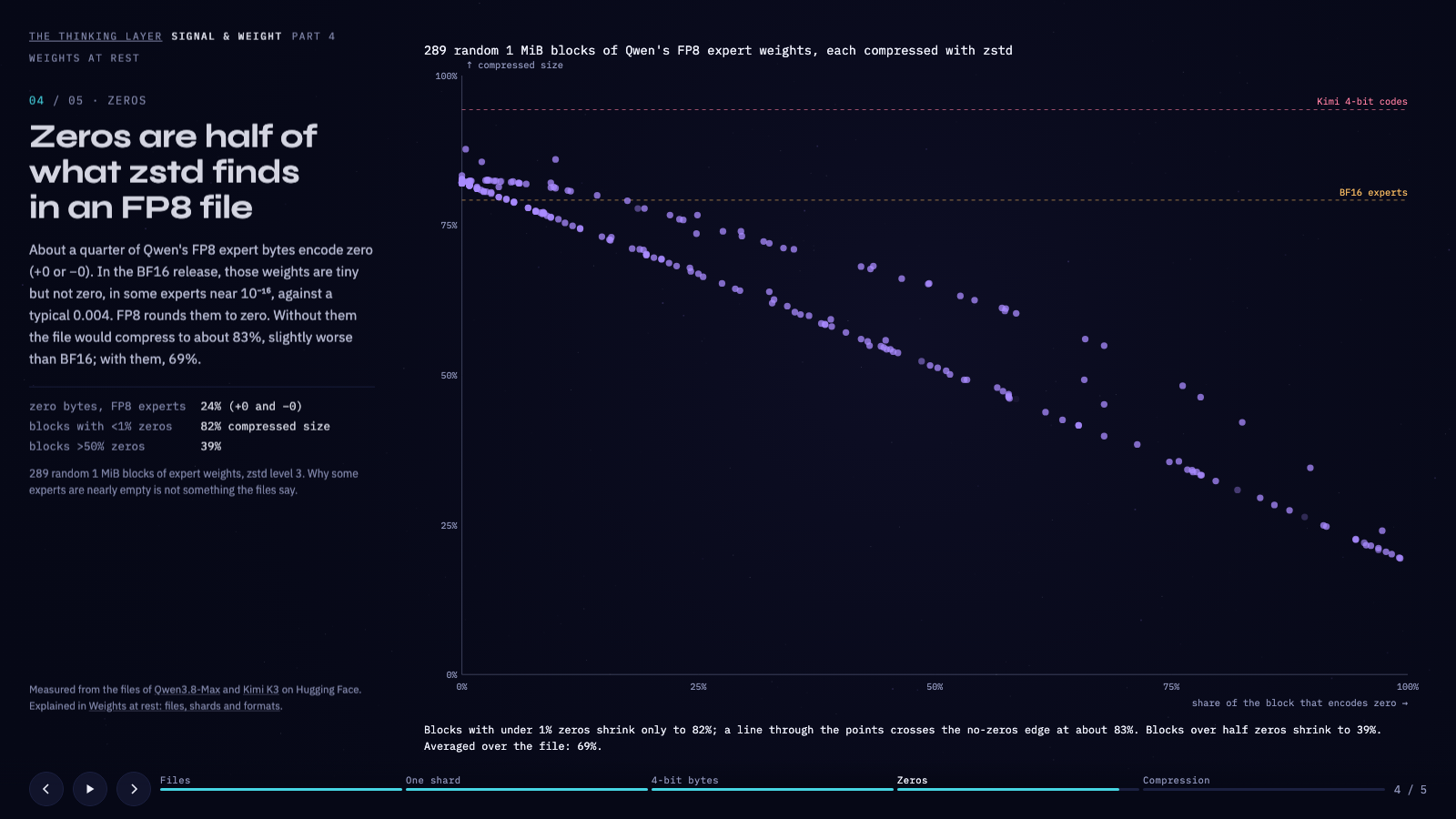
Weights at rest: files, shards and formats
Qwen3.8-Max ships as 213 files and Kimi K3 as 96. I read the header of every one and compressed 900 random 1 MiB blocks of their weights. A quarter of Qwen's FP8 expert bytes encode zero, and rounding saves more space than any lossless compressor I tried.
Compare the models
Inside Open Models
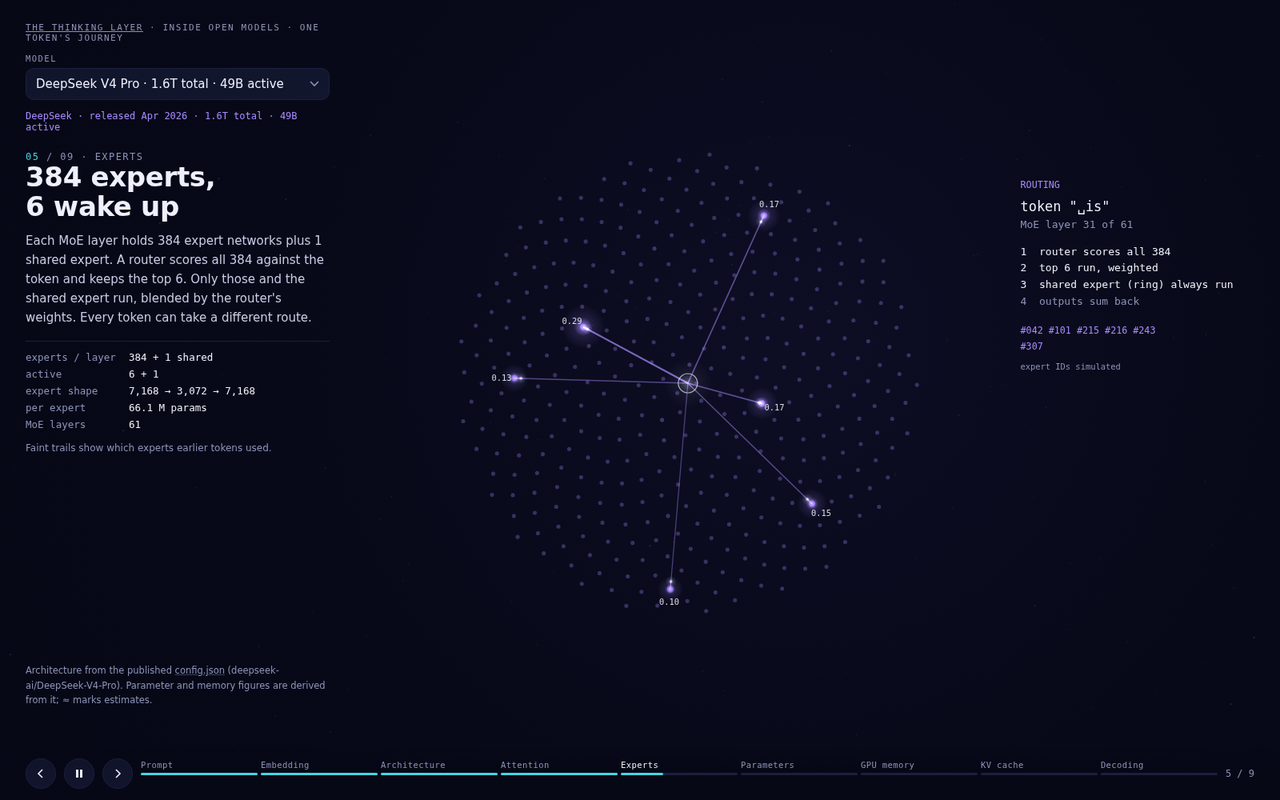
Qwen3.8-Max, Kimi K3, DeepSeek V4, GLM-5.3, gpt-oss, Gemma 4 and more. Pick one and watch the same prompt travel through its real layers, experts, GPU memory and KV cache, computed from each model's published config.
- Smallest
- 1 GPU gpt-oss, Gemma 4, Mistral Small 4
- Largest
- 16 GPUs Qwen3.8-Max, Kimi K3
- Cache spread
- 12× DeepSeek V4 Pro vs Qwen at 128K tokens
Explore by topic
All writing
The break-even bandwidth: when loading a KV cache beats recomputing it
Storage vendors report how many times faster a cached prompt starts. Their own test reports contain a more useful number, the slowest link at which loading still wins. For a 405-billion-parameter model it is about 1 GB per second.
Quantization: the dial that decides how many GPUs you need
Kimi K3 has 14% more parameters than Qwen3.8-Max and 37% fewer bytes. The difference is how many bits each weight gets, and the GPU bill follows from that choice.
What weights actually store
Qwen3.8-Max is 2.50 TB of weights, and not one sentence in it can be looked up. Here's what is in there instead, and why "compression" describes it better than "database".
One token through a 2.4-trillion-parameter model
Every word an LLM writes costs a full trip through its weights. I followed one prompt through Qwen3.8-Max to see what that trip actually looks like, in bytes, GPUs and memory.